
.jpg?la=en&h=360&w=1110&hash=AB9262640BCEAA4ABA2600EA19E8A1EC)
A small, temporary win for the doves, us included
Raymond James Chief Economist Eugenio J. Alemán discusses current economic conditions.
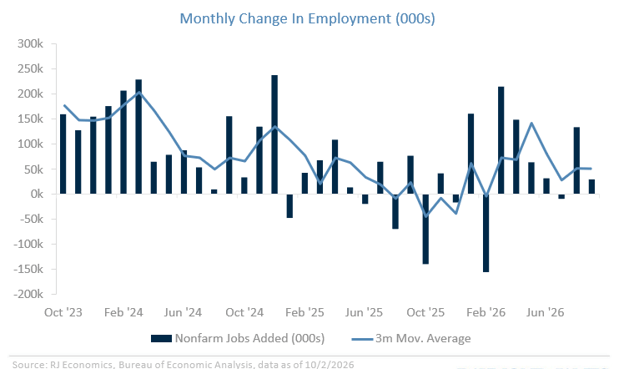
Today’s employment report reinforced a trend that has been evident across several labor market indicators: conditions in the goods-producing sector continue to improve after several difficult years, while hiring across the much larger service sector continues to soften. Nonfarm payrolls rose just 29,000 in September, following a combined 60,000 downward revision to the prior two months. The broader message from the report is that labor market conditions remain weak, particularly within services, even if they are no longer deteriorating meaningfully.
As has often been the case, the Household and Establishment Surveys told somewhat different stories regarding employment growth. However, the measure most relevant to the Federal Reserve from the Household Survey is not employment growth itself but the unemployment rate, which increased to 4.2% in September from 4.1% in August. Although unemployment remains low by historical standards, the report further supports the view that, as former Fed Chair Jerome Powell once noted, “the labor market is not a significant source of inflationary pressure.”
Taken together, the data are consistent with our view that the Fed can afford to remain on hold at the October FOMC meeting while assessing incoming labor market and inflation data before determining whether further policy tightening is warranted in December.
Last week, we argued that the economy was still growing too quickly to deliver a sustained moderation in inflation. This week’s revisions from the BEA strengthen that case. Real GDP growth for the second quarter was revised up to a 2.2% annualized pace from 1.5%, while first-quarter growth was revised up to 2.5% from 2.1%. The stronger second-quarter performance reflected a larger contribution from consumer spending, stronger investment growth led by data-center construction, a smaller drag from government spending and a modest improvement in net exports.
At the same time, we continue to believe that monetary policy has limited influence over many of today’s inflationary pressures and that higher interest rates may, in some respects, work against the Fed’s objective of slowing down economic growth.
To understand why, it is useful to look beyond GDP and examine Gross Domestic Income (GDI), the income-side measure of economic activity. While GDP measures spending across the economy, GDI measures the income generated from production, including wages, profits, proprietors’ income, rental income, net interest income, taxes less subsidies, and depreciation. In theory, GDP and GDI should be identical because every dollar spent becomes income for someone else. In practice, measurement differences can create sizable gaps.
Those gaps have grown substantially in recent years. Following the latest revisions, GDI was estimated to be $197.3 billion below GDP in 2023, $258.7 billion below GDP in 2024 and $334.5 billion below GDP in 2025. Most notably, a significant portion of this discrepancy reflects undercounted net interest income and miscellaneous payments, income streams that are disproportionately earned by higher-income households with substantial financial assets.
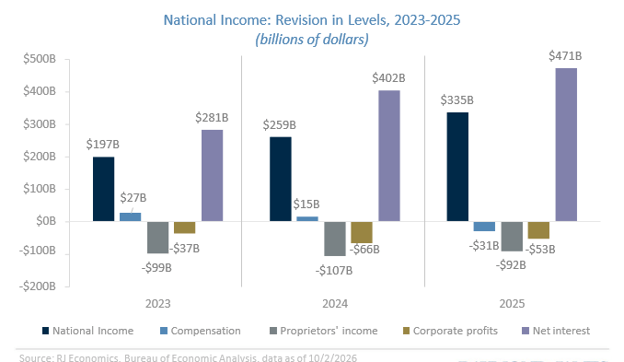
Corporate profits and proprietors’ income were revised lower by roughly $150 billion annually across these years, implying even larger upward revisions to net interest income. The revisions show net interest income was understated by $281.0 billion in 2023, $401.7 billion in 2024 and $470.6 billion in 2025.
The upward revisions to income have extended into 2026. A good example is the personal saving rate. Prior to revision, the July 2026 saving rate was reported at just 3.0%. Following the benchmark revisions, it was raised by 1.6 percentage points to 4.6%. Although the saving rate eased to 4.1% in August, it remains close to its average since the beginning of the century.
The broader implication is that higher interest rates are supporting the income of households that already benefit from substantial financial wealth and strong equity market performance. In other words, tighter monetary policy may be reinforcing the resilience of a K-shaped economy by boosting interest income near the top of the income distribution, even as financial conditions remain restrictive for many other households.
1We typically like to look at these series in real terms, that is, taking inflation out of the equation, to see what is happening to these series without the distortion from inflation. In the graph we include both, year-over-year changes in nominal and real debt levels.
Economic and market conditions are subject to change.
Opinions are those of Investment Strategy and not necessarily those of Raymond James and are subject to change without notice. The information has been obtained from sources considered to be reliable, but we do not guarantee that the foregoing material is accurate or complete. There is no assurance any of the trends mentioned will continue or forecasts will occur. Past performance may not be indicative of future results.
